AIIMS NORCET Study Material: High-Yield Clinical Revision Notes
These aren't generic summaries — every table, chart, and value on this page is clinically verified and has been asked in actual NORCET examinations. Print these, bookmark them, and revise them daily in your final preparation month.
Medically Reviewed by Prof. Sunita Sharma, M.Sc Nursing (Critical Care), Post-Basic B.Sc Nursing
Prof. Sunita Sharma has guided thousands of nursing officers to top ranks in AIIMS NORCET, DSSSB, and ESIC nursing exams. At TopperSquare, she supervises the NORCET clinical scenario tests, drug calculation algorithms, triage questions, and emergency nursing protocols.
Quick-Lookup Clinical Pearls & Tables
| Toxin / Drug Overdose | Specific Antidote | Clinical Indication | Nursing Priority |
|---|---|---|---|
| Paracetamol (Acetaminophen) | N-Acetylcysteine (NAC / Mucomyst) | Within 8–10 hours of overdose | Monitor liver function tests & AST/ALT |
| Heparin (Unfractionated) | Protamine Sulfate (1mg per 100u Heparin) | Bleeding, PTT > 100s | Administer slowly via slow IV push |
| Warfarin (Coumadin) | Vitamin K (Phytonadione) / FFP | High INR (>5), active bleeding | Takes 6–8 hrs to act; use FFP for immediate reversal |
| Opioids (Morphine, Fentanyl, Heroin) | Naloxone (Narcan) 0.4–2mg IV | Respiratory depression < 10/min, pinpoint pupils | Short half-life: watch for repeat sedation within 30 min |
| Benzodiazepines (Diazepam, Midazolam) | Flumazenil (Romazicon) | Severe respiratory sedation | Risk of withdrawal seizures in chronic users |
| Magnesium Sulfate (MgSO4) | 10% Calcium Gluconate (10 mL slow IV) | Loss of DTRs, RR < 12/min, urine < 30ml/hr | Keep 10% Calcium Gluconate at bedside in pre-eclampsia |
| Digoxin (Lanoxin) | Digoxin Immune Fab (DigiFab / Digibind) | Digoxin toxicity (Halo vision, arrhythmias, K+ > 5) | Hypokalemia increases digoxin toxicity risk |
| Organophosphate / Insecticides | Atropine Sulfate + Pralidoxime (2-PAM) | Cholinergic SLUDGE crisis (Salivation, Lacrimation, Bradycardia) | Titrate atropine until bronchial secretions dry |
| Beta Blockers (Atenolol, Propranolol) | Glucagon (IV) | Refractory bradycardia & hypotension | Increases cAMP independent of beta receptors |
| Iron (Ferrous Sulfate) | Deferoxamine (Desferal) | Acute iron poisoning, vin-rose urine | Urine turns reddish-orange during excretion |
| Lead / Heavy Metals | Dimercaprol (BAL) / Calcium EDTA | Plumbism, basophilic stippling | Ensure adequate renal output before chelation |
| Carbon Monoxide (CO) | 100% Hyperbaric Oxygen | Cherry-red skin, headache, pulse oximetry false normal | Use non-rebreather mask at 15 L/min |
| Potassium / Hyperkalemia | Calcium Gluconate (Cardiac membrane stabilization) | Peaked T waves, K+ > 6.0 mEq/L | Follow with Regular Insulin + 25% Dextrose + Kayexalate |
1Emergency Drug Antidotes — Complete Chart
Drug antidote questions appear in nearly every NORCET cycle (verified in NORCET 3, 5, 7, 8, 9, 10). Memorize this table completely:
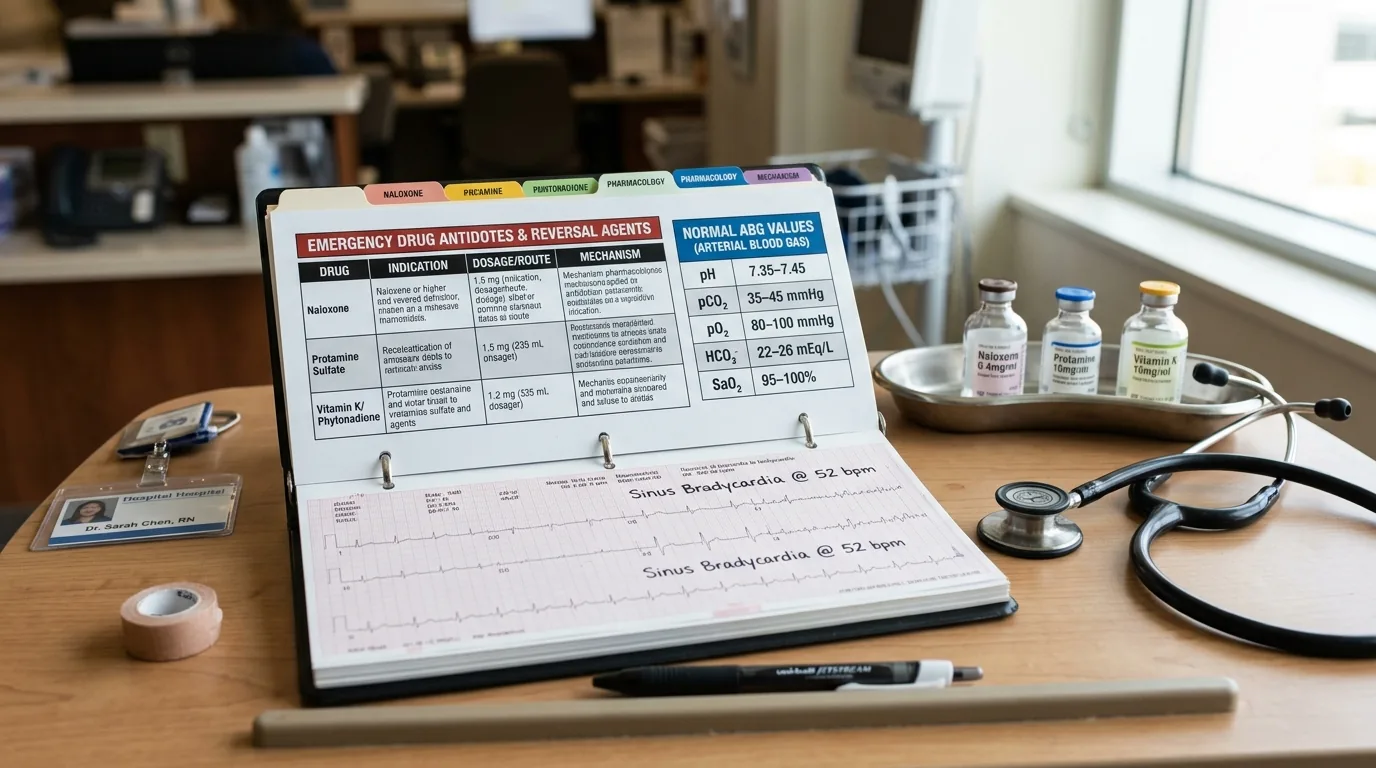
| Toxin / Drug | Antidote |
|---|---|
| Acetaminophen (Paracetamol) | N-acetylcysteine (NAC) |
| Benzodiazepines | Flumazenil |
| Opioids (Morphine, Heroin, Fentanyl) | Naloxone (Narcan) |
| Heparin | Protamine Sulfate |
| Warfarin | Vitamin K (Phytonadione) |
| Digoxin | Digibind (Digoxin-specific antibody fragments) |
| Iron Toxicity | Deferoxamine |
| Organophosphates | Atropine + Pralidoxime (2-PAM) |
| Magnesium Sulfate (MgSO₄) | Calcium Gluconate |
| Isoniazid (INH) | Pyridoxine (Vitamin B6) |
| Methanol / Ethylene Glycol | Fomepizole / Ethanol |
| Lead Poisoning | Dimercaprol (BAL) / Calcium EDTA |
| Methemoglobinemia | Methylene Blue |
2Normal Laboratory Reference Ranges
Serum Electrolytes:
| Parameter | Normal Range |
|---|---|
| Sodium (Na⁺) | 135–145 mEq/L |
| Potassium (K⁺) | 3.5–5.0 mEq/L |
| Calcium (Total) | 8.5–10.5 mg/dL |
| Magnesium (Mg²⁺) | 1.5–2.5 mEq/L |
| Chloride (Cl⁻) | 95–105 mEq/L |
| Bicarbonate (HCO₃⁻) | 22–28 mEq/L |
CBC & Coagulation:
| Parameter | Normal Range |
|---|---|
| Hemoglobin | Male: 13–17 g/dL; Female: 12–15 g/dL |
| WBC Count | 4,000–11,000/mm³ |
| Platelets | 150,000–400,000/mm³ |
| PT (Prothrombin Time) | 11–14 seconds |
| INR | Normal: 0.9–1.2 | Warfarin therapeutic: 2.0–3.0 |
| aPTT | 25–35 sec | Heparin target: 1.5–2.5× control |
3ABG Interpretation Guide (ROME Method)
Normal ABG Values:
| Parameter | Normal Range |
|---|---|
| pH | 7.35–7.45 |
| PaCO₂ | 35–45 mmHg |
| PaO₂ | 80–100 mmHg |
| HCO₃⁻ | 22–26 mEq/L |
| SaO₂ | 95–100% |
The ROME Mnemonic:
- Respiratory = Opposite: pH↑ + CO₂↓ = Respiratory Alkalosis; pH↓ + CO₂↑ = Respiratory Acidosis
- Metabolic = Equal: pH↑ + HCO₃↑ = Metabolic Alkalosis; pH↓ + HCO₃↓ = Metabolic Acidosis
Worked Example:
pH 7.29, PaCO₂ 47 mmHg, HCO₃ 24 mEq/L
→ pH low (acidosis) → PaCO₂ high (respiratory cause) → HCO₃ normal (no compensation)
= Uncompensated Respiratory Acidosis
Apply ABG decision algorithms on actual patient case vignettes in our Clinical Practice Question Bank.
4CPR Guidelines — AHA 2025 (Latest Updates)
| Parameter | Adult | Child | Infant |
|---|---|---|---|
| Compression Rate | 100–120/min | 100–120/min | 100–120/min |
| Compression Depth | ≥5 cm (≤6 cm) | ≥⅓ AP diameter (~5 cm) | ≥⅓ AP diameter (~4 cm) |
| C:V Ratio (no adv. airway) | 30:2 | 30:2 (1 rescuer) / 15:2 (2 rescuers) | 30:2 (1) / 15:2 (2) |
2025 AHA Key Updates (NEW for this exam cycle):
- Foreign Body: Now 5 back blows → 5 abdominal thrusts (adults/children). For infants: 5 back blows → 5 chest thrusts (NO abdominal thrusts for infants)
- Infant Technique: Two-thumb encircling method preferred; two-finger technique no longer recommended for healthcare providers
- Defibrillation Pads: Anterolateral OR anteroposterior position — both are now acceptable
5National Immunization Schedule (NIS) — India
| Age | Vaccines |
|---|---|
| At Birth | BCG, Hep B (birth dose — within 24 hrs), OPV-0 |
| 6 Weeks | OPV-1, Pentavalent-1, fIPV-1, RVV-1, PCV-1 |
| 10 Weeks | OPV-2, Pentavalent-2, RVV-2 |
| 14 Weeks | OPV-3, Pentavalent-3, fIPV-2, RVV-3, PCV-2 |
| 9–11 Months | MR-1, JE-1 (endemic areas), PCV-Booster, fIPV-3, Vit-A 1st dose (1 lakh IU) |
| 16–24 Months | MR-2, JE-2, DPT-Booster-1, OPV-Booster |
| 5–6 Years | DPT-Booster-2 |
| 10 Years | Td |
| 16 Years | Td |
BCG: 0.1 ml intradermal, left upper arm. Pentavalent protects against Diphtheria, Pertussis, Tetanus, Hep B, and Hib. Vitamin A: 1st dose 1 lakh IU at 9 months, then 2 lakh IU every 6 months up to 5 years. Source: MoHFW / CoWIN.
6Recommended Study Resources
- Saunders Comprehensive Review for NCLEX-RN (Silvestri) — Best for clinical priority-action question practice. AIIMS clinical questions closely mirror NCLEX-RN format.
- Target High (Dr. Ajit Golwilkar) — Concise, exam-focused revision for pharmacology and medical-surgical concepts.
- PR Yadav Nursing Competitive MCQs — Most widely used MCQ bank specifically for Indian nursing officer exams.
- IGNOU BNS-109 Study Material — Comprehensive Community Health Nursing reference aligned with Indian public health programs.
- Official AIIMS Information Brochure — Always download the latest brochure from aiimsexams.ac.in for each NORCET cycle.
Apply what you've studied instantly.
Practice clinical MCQs based on these notes in our Full-Length NORCET Mock Tests.
Related Topics
Frequently Asked Questions
What are the normal ABG values?
What is the antidote for heparin?
What is the CPR compression-to-ventilation ratio for adults?
What is the antidote for magnesium sulfate toxicity?
What changed in the AHA 2025 CPR guidelines?
Ready to Crack AIIMS NORCET?
Join thousands of nursing officers preparing with realistic 18-minute section lockout simulations, clinical case vignettes, and AI mark leakage analytics.
18-Min Section Lockouts
AIIMS-exact 5-section timed tests with strict forward progression.
Clinical Case Scenarios
Priority-based triage, ECG strips, and drug calculation questions.
-1/3 Negative Mark Matrix
Rush vs concept error analytics to protect every mark.
100% Free Practice Hub
Full-length mock tests, PYQ series, and revision charts.