AIIMS NORCET Syllabus 2026–2027: Complete Subject-Wise Guide
AIIMS does not publish a standalone syllabus PDF — the official brochure defines the scope as "B.Sc. Nursing / GNM curriculum level," meaning the entire undergraduate nursing curriculum is fair game. This guide breaks down the real subject-wise weightage based on analysis of NORCET 1–10 papers and maps the exact high-yield micro-topics you must master.
Medically Reviewed by Prof. Sunita Sharma, M.Sc Nursing (Critical Care), Post-Basic B.Sc Nursing
Prof. Sunita Sharma has guided thousands of nursing officers to top ranks in AIIMS NORCET, DSSSB, and ESIC nursing exams. At TopperSquare, she supervises the NORCET clinical scenario tests, drug calculation algorithms, triage questions, and emergency nursing protocols.
Subject Weightage Heatmap & Topic Explorer
Medical-Surgical Nursing (MSN)
Dominant (Clinical Scenario Shift)22% – 35%
High-Frequency Topics in NORCET
- 1Cardiovascular (MI MONA, Heart Failure, Shock, ECG Rhythms)
- 2Respiratory (COPD, ARDS, ROME ABG Interpretation, PEEP/FiO2)
- 3Neurology (Glasgow Coma Scale, Increased ICP Cushing Triad, Stroke FAST)
- 4Renal & Electrolytes (Hyperkalemia Calcium Gluconate, AV Fistula Thrill/Bruit)
- 5Endocrine (DKA Kussmaul vs HHS, Insulin Sliding Scale, Thyroid Crisis)
Guaranteed Repeat Pearls
- MONA Protocol for STEMI
- Rule of Nines & Parkland Formula for Burns
- Electrolyte ECG Manifestations (Peaked T in Hyperkalemia)
Ready to test Medical-Surgical?
Attempt topic-wise questions with instant explanations.
Practice Medical-Surgical MCQs1Subject-Wise Weightage from PYQ Analysis (NORCET 1–10)
AIIMS does not publish an official weightage breakdown. The following ranges are derived from crowd-sourced memory-based paper analysis across NORCET 1–10 by Careers360, NPrep, and NursingAllRounder:
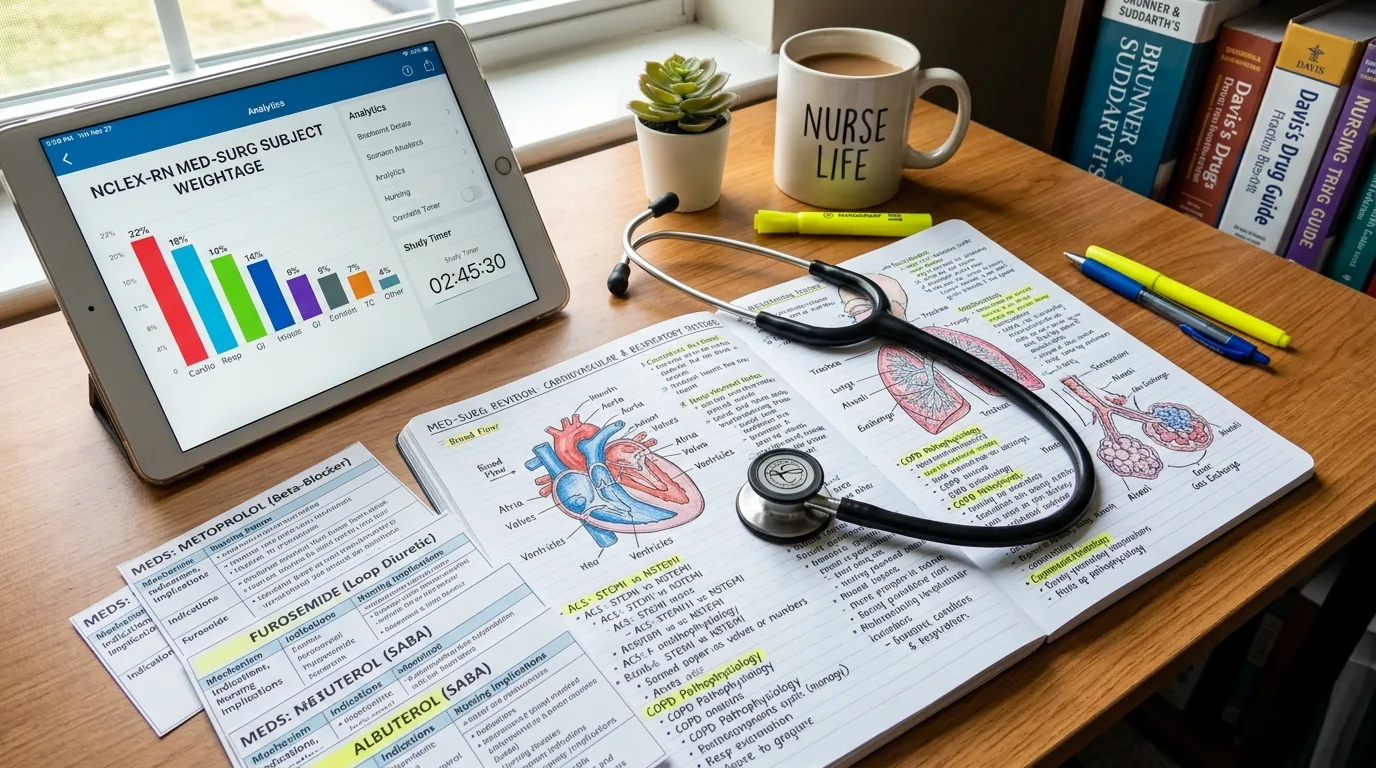
| Subject | Weightage Range | Trend |
|---|---|---|
| Medical-Surgical Nursing (MSN) | 22%–35% | Stable-dominant, shifting to clinical scenarios |
| Obstetrics & Gynaecology | 11%–18% | Stable-high |
| Psychiatric / Mental Health Nursing | 13%–18% | 📈 Increasing sharply since NORCET 7 |
| Pediatric Nursing | 9%–18% | Stable |
| Community Health Nursing | 3%–10% | Stable, focus on National Health Programs |
| Fundamentals of Nursing | 4%–6% | Increasing (infection control, patient safety) |
| GK & Aptitude (Prelims only) | 20 questions | Fixed — the tiebreaker at 93%+ cutoffs |
⚠️ Critical Shift
40%–50% of the NORCET paper now consists of clinical scenario questions — NOT one-liner factual recall. Learn how this format is scored in our NORCET Exam Pattern & Marking Guide, or practice actual scenarios in the Nursing MCQ Practice Section.
2Medical-Surgical Nursing — High-Yield Micro-Topics
MSN accounts for the highest weightage (22-35%) and the most complex clinical scenarios in both Stage I and Stage II:
- Cardiovascular: MI management (MONA protocol — Morphine, Oxygen, Nitroglycerin, Aspirin), Heart Failure (left vs right signs — pulmonary edema vs JVD/peripheral edema), Arrhythmias, Hypertension staging (JNC 8), Shock classification (Hypovolemic vs Cardiogenic vs Septic — nursing priorities differ for each)
- Respiratory: COPD vs Asthma (pursed lip breathing vs tripod position), ARDS (prone positioning rationale), ABG interpretation using ROME mnemonic (see our Full ABG & Electrolyte Tables), Ventilator monitoring (FiO₂, PEEP, tidal volume)
- Neurological: Glasgow Coma Scale (E4V5M6 = 15), Stroke assessment (FAST protocol), Increased ICP — Cushing's triad (hypertension + bradycardia + irregular respirations), Seizure precautions
- Renal: AV fistula assessment (thrill and bruit), Hyperkalemia signs (peaked T waves, widened QRS → priority: Calcium Gluconate IV)
- Endocrine: DKA vs HHS (DKA = Kussmaul breathing + fruity odor; HHS = severe dehydration + altered sensorium), Insulin sliding scale
3Obstetrics, Pediatrics & Psychiatric Nursing
OBG (11-18%):
- Fetal Heart Rate monitoring — Normal: 110-160 bpm. Early deceleration (head compression = normal). Late deceleration (uteroplacental insufficiency = emergency). Variable deceleration (cord compression).
- Pre-eclampsia vs Eclampsia — BP ≥140/90 + proteinuria; eclampsia adds seizures. Treatment: MgSO₄. Antidote for MgSO₄ toxicity: Calcium Gluconate (find all 13 verified antidotes in our Emergency Drug Antidotes Chart).
- Postpartum hemorrhage assessment — >500ml vaginal delivery, >1000ml C-section.
Pediatrics (9-18%):
- Growth milestones: Social smile (2 months), Sits without support (6 months), Walks alone (12 months), First word (12 months)
- Pediatric dosage: Clark's Rule = (Weight in lbs / 150) × Adult dose; Young's Rule = (Age / Age+12) × Adult dose
Psychiatric Nursing (13-18% — rising trend):
- Therapeutic communication — reflection, clarification, restating. Non-therapeutic: "Don't worry," false reassurance, changing the subject
- Antipsychotic side effects — EPS, Tardive dyskinesia, Neuroleptic Malignant Syndrome (hyperthermia + rigidity + altered sensorium = emergency)
4Community Health Nursing — National Health Programs
CHN questions focus heavily on India's National Health Programs and their nursing implications:
- NTEP (National TB Elimination Programme): DOTS protocol, TB-Mukt Bharat targets, MDR-TB management
- NACP (National AIDS Control Programme): HIV prevention strategies, decentralized care model
- RMNCH+A: Reproductive, Maternal, Newborn, Child, Adolescent Health — continuum of care approach
- Mission Indradhanush: Intensified immunization coverage for unreached children (cross-check with our National Immunization Schedule Chart)
- NPCDCS: Prevention and Control of Cancer, Diabetes, CVD & Stroke at community level
- RBSK: Screening for 4Ds — Defects, Deficiencies, Diseases, Developmental Delays
- JSY & JSSK: Janani Suraksha Yojana (institutional delivery incentives) & Janani Shishu Suraksha Karyakram (free care)
5General Knowledge & Aptitude — The 20-Mark Tiebreaker
The GK & Aptitude section (20 questions) appears ONLY in Stage I Prelims. Most nursing students ignore it — but at a 93.59% qualifying cutoff, these 20 marks decide who crosses the line and who doesn't.
- Current Affairs: National and international events, government schemes (latest budget highlights, Ayushman Bharat updates)
- Logical Reasoning: Coding-decoding, blood relations, direction sense, series completion
- Numerical Ability: Percentage, ratio-proportion, time-speed-distance, simple/compound interest
Don't let 20 marks cost you your AIIMS seat.
Practice GK & Aptitude alongside clinical nursing in our NORCET Full-Length Mock Tests.
Related Topics
Frequently Asked Questions
Does AIIMS release a separate NORCET syllabus PDF?
Which subject has the highest weightage in NORCET?
Is the GK section only in Prelims?
How many questions come from Pharmacology?
Ready to Crack AIIMS NORCET?
Join thousands of nursing officers preparing with realistic 18-minute section lockout simulations, clinical case vignettes, and AI mark leakage analytics.
18-Min Section Lockouts
AIIMS-exact 5-section timed tests with strict forward progression.
Clinical Case Scenarios
Priority-based triage, ECG strips, and drug calculation questions.
-1/3 Negative Mark Matrix
Rush vs concept error analytics to protect every mark.
100% Free Practice Hub
Full-length mock tests, PYQ series, and revision charts.